
| Quick answer: Enhanced due diligence (EDD) is a deeper level of screening for higher-risk deals and counterparties. It goes beyond standard checks to cover source-of-funds, sanctions screening, and beneficial ownership verification. Red flags such as politically exposed persons (PEPs), high-risk jurisdictions, and complex ownership structures usually trigger it. |
Money laundering rarely looks suspicious at first glance. The UK’s 2025 National Risk Assessment lists the misuse of UK company structures and cash-intensive businesses among persistent risks, and it points to a growing overlap between money laundering and sanctions evasion.
Standard checks confirm who a counterparty says it is. Enhanced due diligence tests whether that story holds up. If you are a compliance officer, an M&A adviser or a due diligence manager, you may have to explain to a board or a regulator why a deal got extra screening and what you did about it.
This guide shows you when EDD applies, how UK rules treat it (including the changes that took effect on 30 June 2026), and which steps to follow. You also get a checklist you can copy and a look at how VDR audit trails help you keep the evidence.
What is enhanced due diligence?
Enhanced due diligence (EDD) is a deeper round of checks you apply when a customer, counterparty, or deal carries a higher risk of money laundering, terrorist financing, or sanctions breaches. It sits on top of your normal checks. It does not replace them.
What EDD means and where the term comes from
UK law uses the term “enhanced customer due diligence”. It appears in regulation 33 of the Money Laundering Regulations 2017, usually shortened to the MLRs. The regulation says a regulated firm must apply enhanced measures and enhanced ongoing monitoring, on top of its normal checks, when the risk is high.
The idea behind it is risk-based due diligence. You do not check every counterparty to the same depth. UK law calls this a risk-based approach. You scale the work to the risk, so higher-risk clients get more evidence, more scrutiny, and more senior sign-off.
So, what is EDD in practice? It is the extra evidence you collect, the extra people who sign off, and the closer watch you keep once the deal or relationship starts.
The EDD process at a glance
The EDD process follows the same five stages on most deals:
- Spot the trigger. A red flag or your risk assessment shows standard checks aren’t enough.
- Collect more information. You ask for ownership documents, evidence of the source of funds and source of wealth, and the reasons behind the transaction.
- Verify it independently. Check the answers against reliable outside sources, not just what the counterparty sends you.
- Decide and get approval. Senior management reviews the findings and approves, rejects, or sets conditions.
- Monitor and record. You monitor the relationship more closely, watch for suspicious transactions, and keep the evidence on file.
Standard due diligence vs. enhanced due diligence
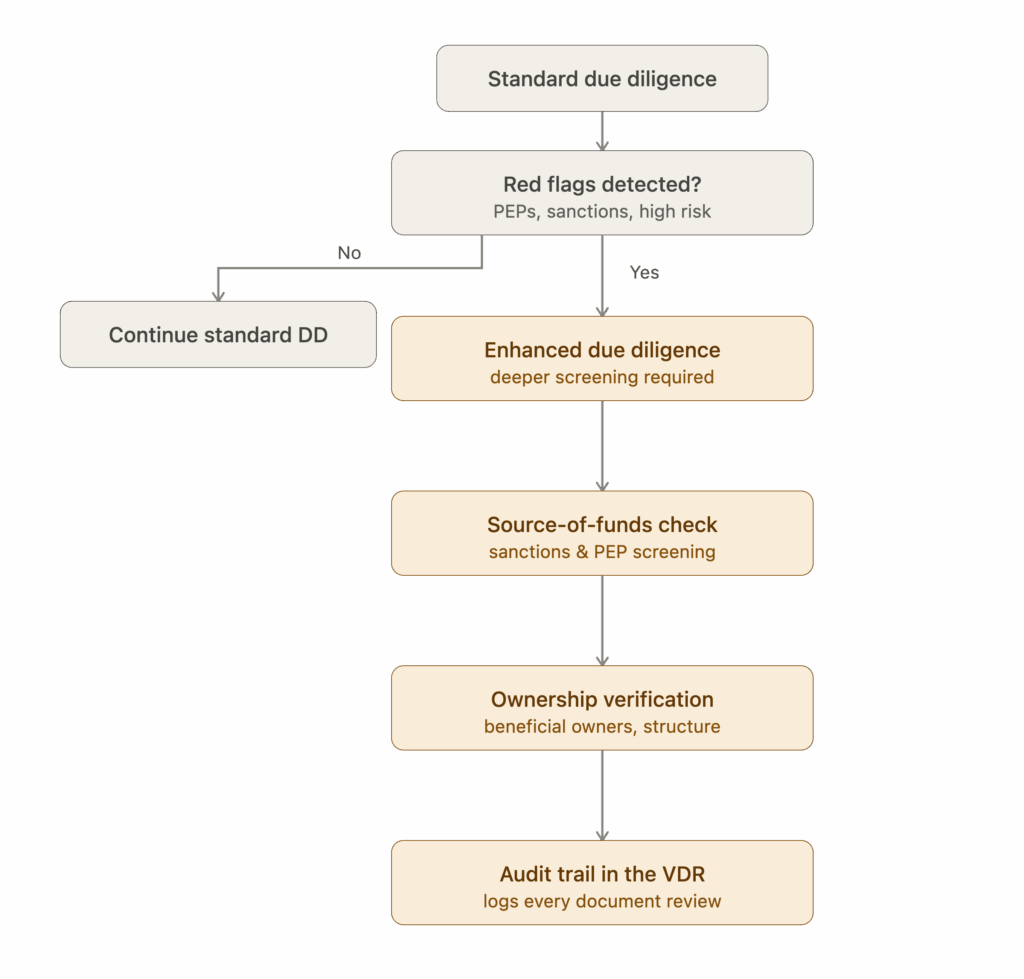
Standard due diligence is the baseline check you run on every counterparty. Our guide on what due diligence is covers that baseline in detail. EDD adds depth when the baseline checks, or the deal itself, raise a concern.
| Area | Standard due diligence | Enhanced due diligence |
| Purpose | Confirm who the counterparty is and what the deal involves | Test higher-risk claims and rule out laundering, sanctions and corruption risks |
| When it applies | Every counterparty | Only where risk is high, or a trigger applies |
| Identity and ownership | Identify and verify the party and its beneficial owners | Map the full ownership chain, including nominees and layered entities |
| Source of funds and wealth | Only when the risk calls for it | Required, with supporting evidence |
| Screening | Sanctions and PEP checks | The same checks, plus adverse media, litigation history, and a closer jurisdiction review |
| Approval | Standard sign-off | Senior management approval |
| Monitoring | Routine | More frequent, with set review dates |
| Records | Standard file | Detailed file that shows your reasoning |
In short, EDD changes how deep you go, not what you look for. Under due diligence UK rules, you match the depth of your checks to the level of risk, and you explain that choice. You also do not have to apply EDD to a whole deal. You can apply it to the part that raised the flag, such as one investor or one seller entity.
Red flags that trigger enhanced due diligence
Some red flags make EDD mandatory for regulated firms that deal with high-risk customers. Others are warning signs that should prompt closer scrutiny. Regulation 33 sets out the legal triggers and risk factors to weigh. Watch for these seven.
- A politically exposed person in the deal is a standard trigger. A PEP is an individual entrusted with a prominent public function, and the rule also covers their family members and known close associates. Since 10 January 2024, UK domestic PEPs start from a lower-risk position than foreign PEPs, but they still need EDD.
- Exposure to a high-risk jurisdiction is a trigger. Since 30 June 2026, the mandatory legal trigger covers countries on the Financial Action Task Force (FATF) “call for action” list, which in June 2026 named North Korea, Iran and Myanmar. Other higher-risk countries remain a geographical risk factor you must weigh. FATF updates its lists three times a year, so check the latest version before you rely on this one.
- Sanctions exposure is a separate test from anti-money laundering rules. UK financial sanctions can reach entities that are owned or controlled by a designated person, even when the entity itself is not named on the UK Sanctions List.
- A complex or opaque ownership structure is a listed risk factor. This is especially true when it is unusual or excessively complex for the nature of the business. Nominee shareholders and shares in bearer form sit on the same list.
- A cash-intensive business model is another listed risk factor. This is because cash makes it harder to trace the source of the money.
- Adverse media findings are a practical warning sign. These include credible reports of fraud, bribery, or links to crime in the news or in court records. The regulation does not name them, but they feed your risk assessment. Check that a report is credible and about the right person before you act on it.
- Unusual transactions trigger EDD under regulation 33(1)(f). This applies when transactions are unusually complex or large for their type, follow an unusual pattern, or have no apparent economic or legal purpose.
Enhanced due diligence and UK regulation
The MLRs apply to “relevant persons”, such as banks, law firms and accountants. If your business is not one of them, the legal duty to apply EDD may not bind you directly. However, the principal money laundering offences in the Proceeds of Crime Act 2002 apply to everyone, so many businesses follow EDD as good practice on higher-risk deals. This article is general information, not legal advice. Confirm your position with counsel.
FCA expectations on enhanced due diligence
The FCA supervises many firms subject to the MLRs. Its guidance on PEPs, FG17/6, says it expects firms to take “appropriate but proportionate” measures to meet their financial crime obligations. In other words, the FCA does not ask for the maximum level of checks on every file. It asks for checks that fit the risk.
For a PEP, the MLRs require senior management approval, adequate measures to establish source of wealth and source of funds, and enhanced ongoing monitoring. They also require enhanced checks on the relationship once it starts. The FCA guidance dates from July 2017. After the January 2024 rule change on domestic PEPs, the FCA consulted on updating it, so check the FCA website for the current version.
Money Laundering Regulations and AML obligations
Regulation 33(1) says a relevant person must apply EDD and enhanced ongoing monitoring in these cases:
- A risk assessment identifies the case as high risk.
- The business relationship or transaction involves a person established in a FATF call-for-action country.
- The relationship is a correspondent relationship with a credit or financial institution.
- The customer is a PEP, or a family member or known close associate of one.
- A customer has given false or stolen identification documents, and you plan to keep dealing with them.
- A transaction is unusually complex or unusually large, follows an unusual pattern, or has no apparent economic or legal purpose.
- Any other case presents a higher risk by its nature.
The Money Laundering and Terrorist Financing (Amendment) Regulations 2026 changed two of these triggers on 30 June 2026, according to the ICAEW:
- First, the mandatory country trigger now covers only FATF call for action countries.
- Second, the transaction trigger is now judged against what is normal for that type of transaction. Firms must still assess geographical risk and apply EDD wherever they find a high risk.
The regulation also says what EDD should include. For call-for-action countries, Regulation 33(3A) sets minimum steps. You must get extra information on the customer and its beneficial owner, and on the purpose of the relationship. You must also obtain source-of-funds and source-of-wealth details, the reasons for the transactions, and senior management approval, and you must monitor more closely. In other cases, Regulation 33(5) gives examples, such as seeking additional independent sources and taking further steps to understand the customer’s ownership and financial situation.
What UK businesses are required to document
Regulation 40 requires relevant persons to keep copies of the documents and information they obtained for their due diligence checks, including EDD under regulations 33 to 37, plus enough records to reconstruct transactions. The standard retention period is five years from the end of the relationship or transaction. Regulated firms must also keep a written risk assessment under regulation 18.
Your EDD file should show:
- Why EDD was applied, and who decided.
- The information you requested and what you received.
- Evidence for the source of funds and source of wealth.
- Screening results and how you cleared each alert.
- Who approved the relationship, and when.
- The monitoring plan and the next review date.
Enhanced due diligence checklist
Use this enhanced due diligence checklist as a starting point. Adapt it to your deal, your risk assessment, and your supervisor’s expectations. Treat each item as a question you must be able to answer with evidence, not as a box to tick.
- Confirm why EDD applies. Record the trigger, the date, and the person who made the call.
- Verify identity and beneficial ownership. Collect identity documents and check them against the company register or other independent records.
- Map the full ownership and control structure. Chart every layer up to the individuals who ultimately own or control the entity, and note any nominee, trust, or offshore holding.
- Confirm source of funds and source of wealth. Ask for evidence such as audited accounts, sale agreements, tax returns, or bank statements, and check that it fits the size of the deal.
- Screen against sanctions and PEP lists. Screen the entity, its owners, directors and known associates, and record how you cleared each alert.
- Check adverse media and litigation history. Search news, court records and regulator notices, and confirm that each hit relates to the right person.
- Assess jurisdictional risk. Review where the parties are based and where the funds come from and go, against the current FATF lists and your own risk assessment.
- Understand the purpose of the transaction. Confirm that the structure, size, and timing make commercial sense.
- Get senior management approval. Present the findings and record the decision, including any conditions.
- Document your rationale and set ongoing monitoring. Save the full file, set a review date, and define what would trigger an earlier review.
How EDD differs from KYC and customer due diligence
EDD, KYC, and customer due diligence overlap, which is why teams often mix them up. The difference comes down to depth and trigger.
Where KYC ends, and EDD begins
Know your customer (KYC) confirms a customer’s identity. Basic KYC checks include collecting identity documents, verifying them, and understanding the customer’s activities.
In practice, enhanced due diligence (EDD) starts when those checks leave questions unanswered or when risk is high. At that point, you move from “who are you?” to “where did the money come from, and why is this structure needed?”
How customer due diligence fits into the wider process
Customer due diligence (CDD) is the legal framework that KYC sits in. UK law, set out in the 2017 Regulations, uses three levels, and you pick the level based on risk.
| Level | When it applies | Typical depth |
| Simplified due diligence | Lower-risk cases, with enough monitoring to spot unusual activity | Reduced measures |
| Customer due diligence | The default for most customers | Identify and verify the customer, its owners and the purpose of the relationship |
| Enhanced due diligence | High-risk cases | Extra evidence, senior approval and closer monitoring |
The enhanced due diligence requirements in Regulation 33 add to standard customer due diligence. They never replace it.
How VDR audit trails support EDD evidence
An EDD file is only useful if you can show what you collected, who saw it, and when. A virtual data room (VDR) gives you one controlled place to hold that file. If you review large document sets, an AI data room can also help you search and summarise them, but check any AI output against the source documents before you rely on it.
| What you need to prove | VDR feature to look for | What it shows |
| Your view changed as facts emerged | Version control | Each draft of the risk assessment and when it changed |
| Only approved people saw sensitive files | Access logs | Who opened, downloaded or printed each file, and when |
| Sensitive files stayed controlled | Watermarking and document-level permissions | Who could view, download or print, and a trace if a copy leaks |
Version control for evolving risk assessments
Risk assessments change as new facts come in. A new ownership document or a screening hit can change a customer’s risk profile and move a counterparty from medium to high risk. Version control keeps every earlier draft, so you can show what you knew at each point and when you changed your view. This matters when a regulator or auditor asks why you reached a decision.
Access logs: Who viewed what, and when
Access logs record which users opened, downloaded, or printed each file, and when. For EDD, they can show that only approved people reviewed sensitive material, such as PEP findings or source of wealth documents. They can also show that the approver opened the full file before signing off.
Watermarking and document-level controls
Dynamic watermarks mark each viewed or printed page with the user’s details. Document-level permissions let you limit who can view, download, or print a file. Together, they discourage leaks of sensitive material and help you trace the source if a copy goes astray. Feature names and options differ between providers, so check what your VDR offers before you rely on it.
When a regulator or auditor asks for evidence, you want to hand over the documents, the decision record, and the activity log together. Look for a VDR that lets you export the activity log alongside the files. That gives the reviewer one clear account instead of scattered emails.
FAQ
How does EDD differ from standard due diligence?
Enhanced due diligence (EDD) goes deeper and applies only to higher-risk cases. Standard checks confirm identity and ownership. EDD adds evidence of source of funds and source of wealth, closer screening, senior management approval, and tighter monitoring.
What triggers enhanced due diligence?
Regulation 33’s legal triggers include PEPs, FATF call for action countries, unusually complex or large transactions, false identity documents, and any case you assess as high risk. Risk factors such as complex ownership, a cash-intensive business, and nominee shareholders increase your risk assessment.
Is enhanced due diligence a legal requirement in the UK?
Yes, for regulated firms in the cases listed in Regulation 33. If the MLRs do not apply to your business, the regulation does not bind you directly. Money laundering offences and sanctions rules can still apply to you, so many businesses apply EDD voluntarily. Check with counsel.
How long does enhanced due diligence take?
UK regulations set no fixed timeframe. The time depends on the complexity of the ownership, how quickly the counterparty provides documents, and how many countries are involved. Start as soon as a trigger appears and build the time into your deal timeline.